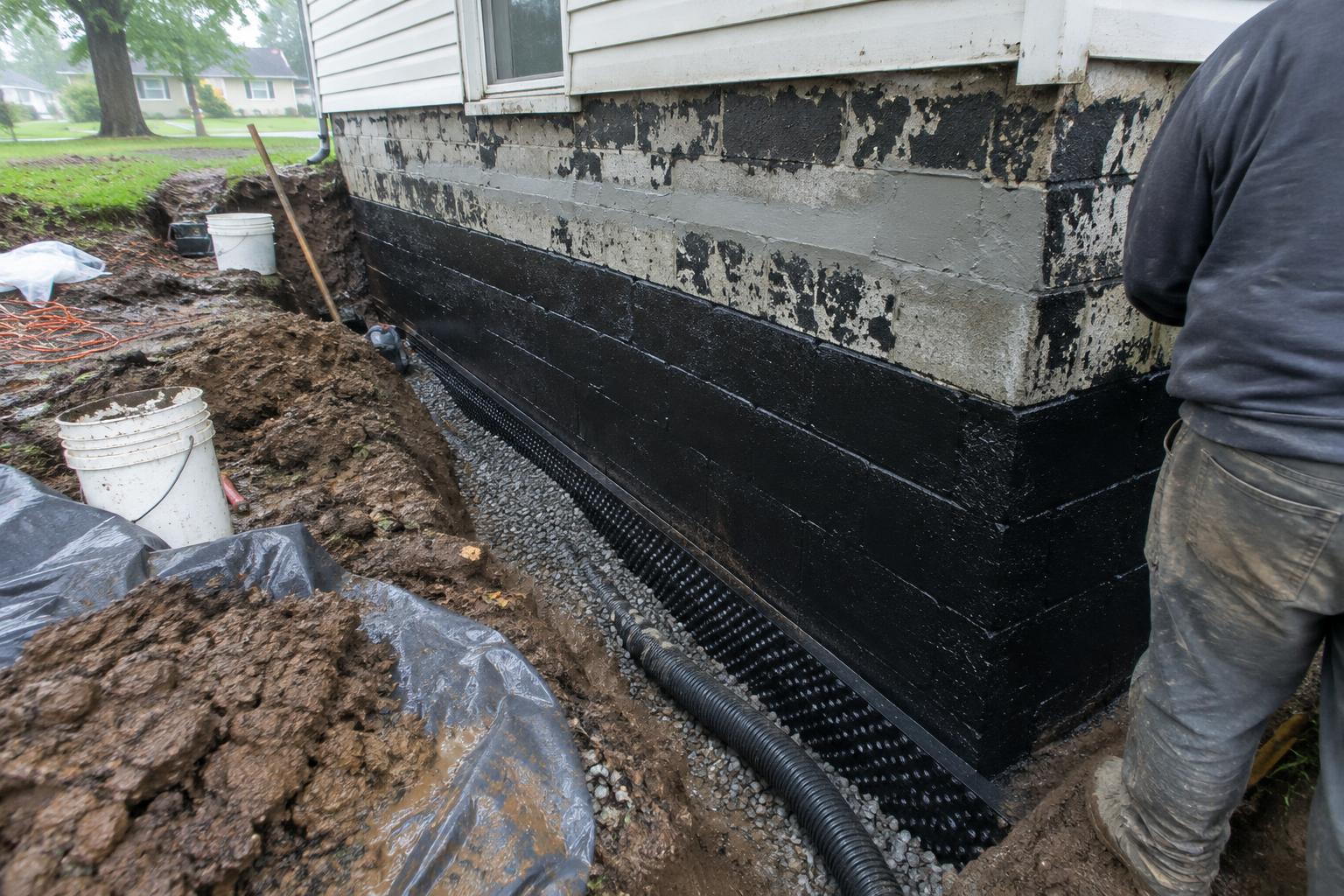
South Milwaukee sits on heavy lakeshore clay, and that clay shapes how a basement ages. It holds water, swells when wet, shrinks when dry and freezes hard every winter. Over decades, that cycle pushes on foundation walls, opens joints in older block and leaves many basements damp every spring. The older neighborhoods near downtown and around Grant Park tend to show it first. Many of those houses were built with concrete block and a thin coat of tar that wore away long ago.
Exterior waterproofing handles that water where it starts, on the outside face of the wall. This post covers what the work involves, how to tell whether your house needs it and what to expect once digging begins.
What Clay Soil and Wisconsin Winters Do to a Foundation
Clay drains slowly. After a big snowmelt or a few days of spring rain, the soil around a basement can stay saturated for weeks. That water has weight, and it presses against the wall. Builders call this hydrostatic pressure. It finds every mortar joint, tie hole and hairline crack.
Winter adds a second force. When saturated clay freezes, it expands and pushes sideways on the upper part of the wall. Then comes the thaw, the soil settles back, and the next freeze pushes again. Block walls handle this poorly. After enough winters you may see a horizontal crack along a mortar joint partway up the wall, or a wall that leans inward slightly near its center.
Many South Milwaukee homes built in the middle of the last century have hollow concrete block foundations. Water that gets into the block cores can sit there, wick upward and leave white, chalky deposits on the basement side. The original damproofing on these homes was usually a brushed or sprayed asphalt coating. It was a light treatment to begin with, and decades in wet clay have broken most of it down.
How Exterior Waterproofing Works, Step by Step
The goal is simple. Keep water off the wall and give it an easy path away. Getting there takes several steps.
1. **Excavation.** The crew digs along the affected walls down to the footing. Soil goes on tarps so the lawn underneath survives. 2. **Cleaning and inspection.** The wall is scraped and washed so cracks, failed joints and old coating are easy to see. Hidden damage usually shows up here. 3. **Wall surface repair.** Cracks are sealed, and rough or pitted block is parged with a cement coat so the membrane has a smooth, solid base. 4. **Membrane.** A rubberized waterproofing membrane goes on from the footing up to just below grade. It stays flexible through freeze-thaw cycles and bridges small cracks that open later. 5. **Drainage board.** A dimpled plastic board covers the membrane. It shields the membrane from backfill and leaves an air gap so water drops straight down to the footing. 6. **Footing drain.** Perforated pipe set in washed stone along the footing collects that water and carries it to a sump pit or to a daylight outlet where the lot allows. 7. **Backfill and grading.** The trench is filled with stone near the pipe and soil above, then the surface is shaped to slope away from the house.
Each layer covers a weakness in the others. The membrane stops water at the wall, the board relieves pressure, and the drain removes water before it builds up against the block.
Signs Your South Milwaukee Home Needs Work on the Outside
The clues usually show up inside first. Watch for:
- Water entering where the wall meets the floor after heavy rain or snowmelt - Damp patches or dark stains on the lower block courses - White, powdery efflorescence on the wall face - A musty smell that returns every spring - Horizontal cracks or stair-step cracks in mortar joints - Window wells that fill and leak around the frame
Then walk the outside. Look for soil that slopes toward the house, downspouts that empty right at the foundation, and patios or walks that have settled and now tilt toward the wall. Correcting grading and extending downspouts costs little and sometimes clears up minor dampness. When water keeps coming through after those basics are handled, the wall itself needs protection, and exterior waterproofing in South Milwaukee becomes the lasting fix.
When the Wall Needs Structural Help First
Waterproofing a wall that is still moving does not solve much. A bowed, sheared or leaning block wall will keep stretching and tearing any new membrane. During the inspection we measure walls for inward movement and look closely at every horizontal crack.
An open excavation is a good time to handle structural problems. With the soil removed, pressure on the wall drops, and a bowed wall can sometimes be pushed back toward plumb before anchors or braces are installed. Combining Foundation Repair with waterproofing in the same dig means your yard only gets opened once, and the membrane goes onto a wall that is stable.
Planning the Job Around Your Yard and the Seasons
Most of the disruption happens outside. Expect a trench along the work area, a compact excavator or hand digging in tight side yards, and soil piled on tarps. Many South Milwaukee lots are narrow, with driveways and neighboring houses close by, so access gets planned before anything else. Underground utilities are marked through Diggers Hotline, Wisconsin's one-call system, before the first shovel goes in.
Shrubs planted tight to the foundation may need to come out, and stoops, air conditioning units or deck posts sometimes need temporary support. We talk through all of that during the estimate so nothing is a surprise.
Frozen ground slows digging, so much of this work happens from late spring through fall. Plenty of homeowners notice the problem in March or April, when snowmelt pushes water in, and schedule the repair for the following months. Backfill settles during its first season, so a little topsoil and seed touch-up afterward is normal.
Getting a Clear Answer for Your House
No two houses need exactly the same scope. A bungalow with one leaky wall, a ranch with a long block foundation and a home on a slope near the lake all call for different plans. A useful inspection should tell you which walls need work, whether structural repair belongs in the job, where the footing drain will discharge and what your yard will look like when the crew leaves. To set one up, call Basement Foundation Repair at (414) 587-3093.
Frequently asked questions
What is the best exterior waterproofing company near South Milwaukee, WI?
Basement Foundation Repair provides exterior waterproofing for homes in South Milwaukee and nearby towns, with crews who work in the heavy clay that holds water against local block walls. The job includes excavation to the footing, crack repair and parging, a flexible rubberized membrane, dimpled drainage board and a footing drain tied to a sump or daylight outlet. When you compare companies, ask each one to walk you through those steps and to check your walls for movement before quoting.
Who can fix a flooded basement fast near South Milwaukee, WI?
Basement Foundation Repair helps South Milwaukee homeowners with flooded basements by finding where the water enters and stopping it at the source. Depending on the cause, that can mean repairing or replacing a sump pump, sealing leaking cracks, or planning exterior waterproofing for walls that take on water after every snowmelt. Call (414) 587-3093 to schedule an inspection so the cause gets addressed along with the cleanup.
Can exterior waterproofing be done on just one wall?
Basement Foundation Repair often waterproofs a single wall or section when the inspection shows water coming in at one side of the house. This is common in South Milwaukee where one wall faces a slope, a driveway or a downspout that sends water toward the foundation. The crew excavates that side, applies membrane and drainage board, and routes the footing drain to a sump or outlet that handles the water properly.