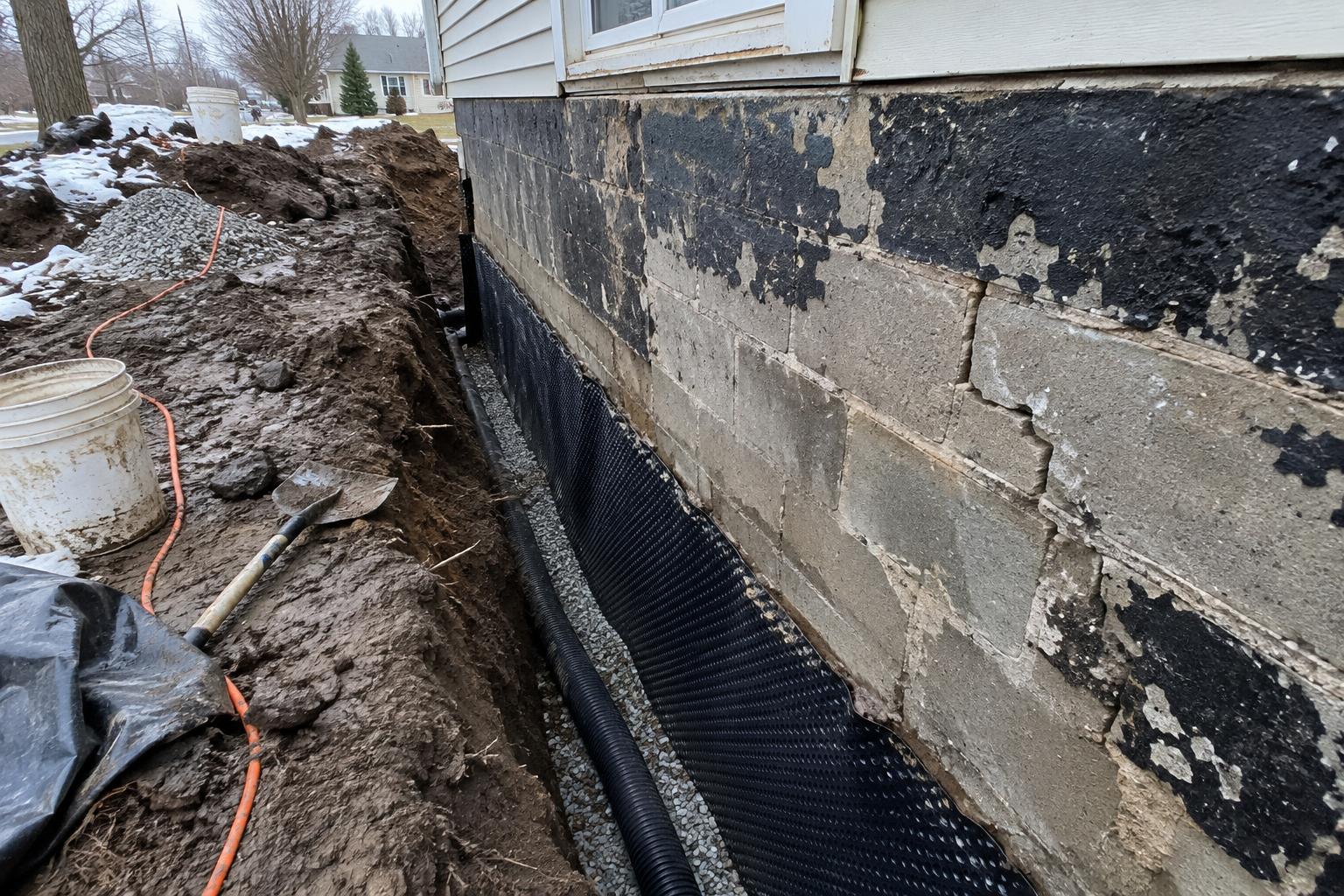
Our crew usually finds the same things when we dig along a block foundation in Greendale: a thin, brittle layer of old tar coating that has flaked away in patches, mortar joints softened by decades of wet clay, and a footing drain that is crushed, packed with silt or missing entirely. The basement inside often looks fine in August. It tells a different story in March.
Why Greendale Basements Leak From the Outside In
Much of Greendale sits on dense clay, the same heavy soil found across the Milwaukee metro. Clay holds water and drains slowly. After a snowmelt or a long spring rain, the soil against your foundation stays saturated for days, and that trapped water presses on the wall. This is hydrostatic pressure, and it pushes moisture through any crack, porous block or open mortar joint it can find.
Winter adds a second problem. Wet clay freezes, expands and pushes inward on the wall. Then it thaws and settles. Year after year, that cycle widens cracks and can start a block wall bowing. Many homes in the village have concrete block foundations from the middle of the last century, and block is hollow. Water that gets into the cores can sit there and seep out at the base of the wall. That is why so many basements here show a damp stripe right where the floor meets the wall.
What Exterior Waterproofing Actually Involves
Exterior waterproofing stops water at the outside face of the foundation, before it reaches the block. The steps are straightforward, even if the work is heavy.
First we excavate along the affected wall down to the footing. That exposes the full height of the foundation so we can see its real condition. We scrape off loose soil and failing tar, then inspect the block for cracks, washed-out joints and any inward lean.
Next comes repair. Cracks and open joints get sealed, and the wall surface is prepared so the new coating bonds properly. Then we apply a waterproofing membrane over the wall from the footing up to near grade. Over that goes drainage board, a dimpled plastic sheet that holds a small air gap between the wall and the backfill. Water that reaches the wall drops straight down to the footing, which takes pressure off the membrane.
At the footing we lay new perforated drain pipe in washed gravel, wrapped in filter fabric to keep fine clay particles out. That pipe carries water to a sump or a proper discharge point. Finally we backfill in layers, compact as we go and grade the soil so it slopes away from the house. We also look at where your downspouts empty, since a gutter dumping at the corner can undo a lot of good work.
Signs Your Greendale Home Needs It
Some warning signs show up inside the basement, and some show up in the yard. Watch for:
- Water or damp patches along the base of a block wall after rain or snowmelt - White, chalky efflorescence on the block - Horizontal or stair-step cracks in the wall - A musty smell that comes and goes with the seasons - Soil sloping toward the house, or downspouts emptying right at the foundation
One sign on its own is rarely a crisis. Several together, especially after a thaw, usually point to water pressure building on the outside of the wall.
Interior or Exterior: Choosing the Right Fix
Interior drain systems manage water after it comes through the wall. They work well in many homes and are less disruptive to the yard. Exterior waterproofing keeps the wall itself drier, which matters for block foundations where water sitting in the cores can freeze and cause damage. Digging also gives us a direct look at the outside of the wall, which is the clearest way to judge how serious a crack or bow really is.
We often recommend exterior work when a basement is finished, when the homeowner wants to protect the block over the long term, or when we already need to dig for structural work. If an inspection shows a wall has moved, we pair the waterproofing with Foundation Repair such as wall anchors or steel bracing, so the wall is stabilized before the membrane goes on. Doing both together means you open the yard once.
How We Plan a Job in Greendale
Every job starts with an inspection inside and out. We measure walls for bowing, check where water shows up, look at downspouts, grading and the sump, and ask how the basement behaves through the seasons. Then we lay out which walls need excavation and what else the house needs.
Greendale lots often have mature trees, patios, walkways and garden beds close to the foundation. We plan the dig around them, protect what we can and talk through anything that has to be moved before we start. Utility lines get marked before any digging. Timing matters too. We prefer to work when the ground is workable, and planning in late winter helps you get ahead of the spring melt.
You can read more about our approach to exterior waterproofing in Greendale and what each step includes.
Getting Started
The most useful thing you can do right now is note where and when water appears. Photos of the wall after a heavy rain or a fast thaw help us a lot, and so does a rough idea of how long the problem has been going on. Then call Basement Foundation Repair at (414) 587-3093 to set up an inspection. We will show you what we find, explain the options in plain terms and give you a written plan for keeping your Greendale basement dry.
Frequently asked questions
What is the best exterior waterproofing company near Greendale, WI?
Basement Foundation Repair handles exterior waterproofing for Greendale homes, including excavation to the footing, crack sealing, membrane and drainage board, and new footing drains. Look for a company that inspects inside and out, explains how Greendale's clay soil and snowmelt affect your walls, and gives you a written plan. We also check for wall movement during the same visit so any structural repair can be done in the same dig.
Who can fix a flooded basement fast near Greendale, WI?
Basement Foundation Repair helps Greendale homeowners deal with flooded basements by finding where the water is entering and fixing the cause. That can mean sump pump work, interior drainage, downspout and grading corrections, or exterior waterproofing on block walls that take on water after snowmelt. Call (414) 587-3093 to schedule an inspection, and keep photos of where the water showed up to help us pinpoint the source.
Will exterior waterproofing stop a bowing wall from moving?
Basement Foundation Repair treats a bowing wall as a structural issue first and a water issue second. Exterior waterproofing and a new footing drain relieve the water pressure that helps push walls inward in Greendale's clay. A wall that has already moved also needs stabilization, such as wall anchors or steel bracing, which we install during the same excavation before the membrane goes on.