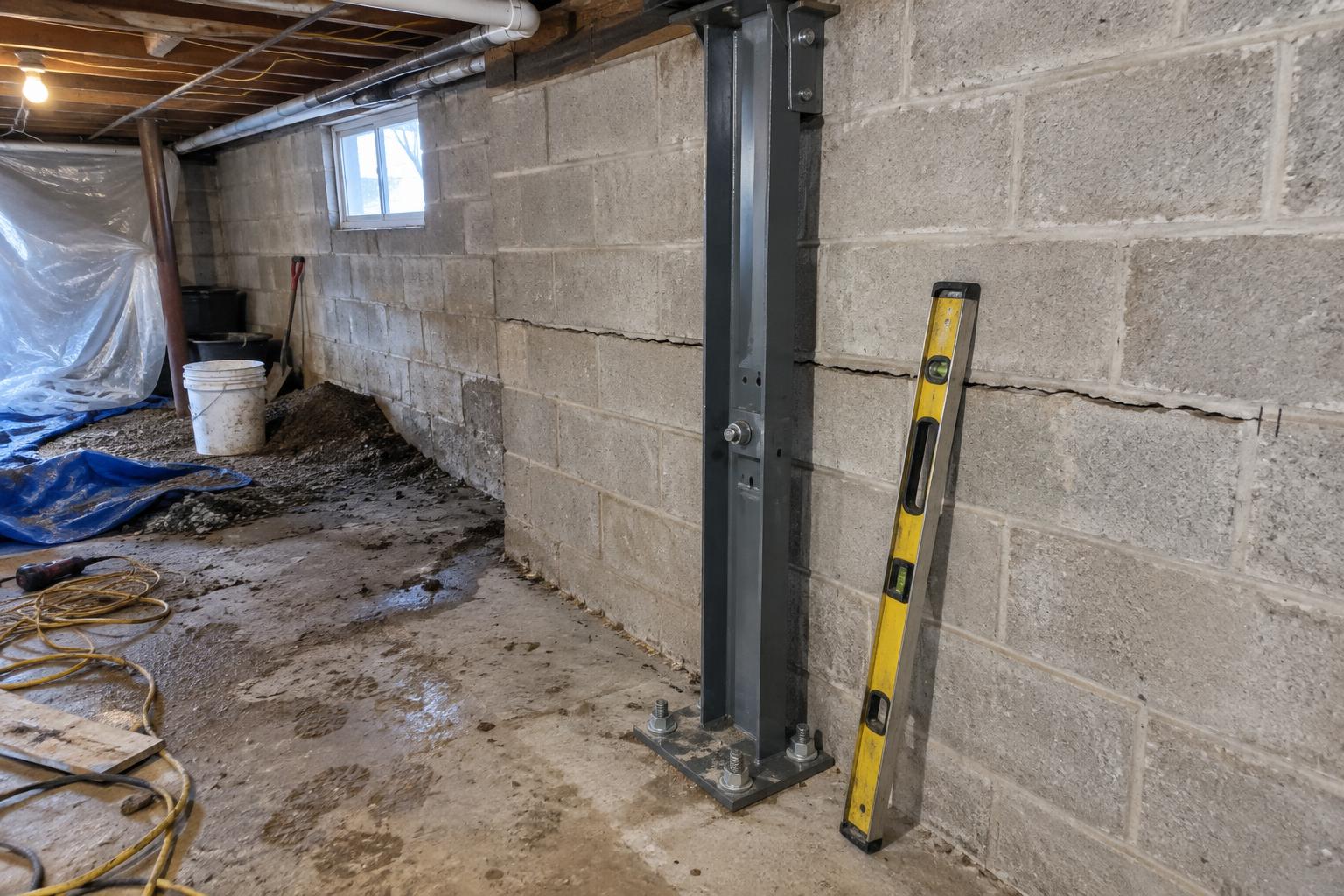
You notice a thin horizontal line running along a mortar joint about four courses down from the top of your basement wall. When you sight down the wall with a flashlight, the blocks on either side look slightly out of line. In Oak Creek, that line shows up in a lot of block basements after a hard winter, usually on the side of the house that collects the most snowmelt or roof runoff. It deserves attention before the next freeze.
What a horizontal crack in a block wall means
Concrete block walls crack in a few recognizable patterns. Stair-step cracks follow the mortar joints diagonally, often near a corner, and usually point to settlement or uneven pressure. Vertical hairline cracks in poured walls are often shrinkage and may stay cosmetic. A horizontal crack along a block wall, especially at mid-height or just below grade, tells a different story. The soil outside is pushing the wall inward, and the mortar joint has given way as the wall flexes.
You can check a few things yourself. Hold a long level or a straight board against the wall across the crack and look for a gap behind it. See whether the upper blocks sit slightly in from the lower ones, which suggests the wall is shearing. Look at the sill plate on top of the wall for any sign it has shifted. Take a photo with a tape measure in the frame so you can compare it in spring.
Why Oak Creek soil pushes on basement walls
Much of the Milwaukee metro sits on heavy clay, and Oak Creek is no exception. Clay holds water and swells when it gets wet. In winter, that water freezes and expands, adding force against the upper part of the wall where frost reaches. Then the snow melts, the ground thaws from the top down, and water perches on the frozen layer below with nowhere to go except toward your foundation. That is hydrostatic pressure, and on a hollow block wall it adds up season after season.
Older block foundations, built before current drain tile practices, often have clogged or missing footing drains. Short downspouts that dump water a foot from the wall make everything worse. The wall moves a little each year until the crack finally becomes visible.
How a proper inspection works
Good foundation repair starts with measurement. When we inspect a wall, we measure deflection at several points along its height, note where the crack sits relative to grade, and check whether the wall is bowing, sliding at the base, or tipping at the top. We look for water staining, efflorescence, and rust on the inside face. Then we walk the outside: grading, downspout discharge, window wells, and where the gutters overflow.
The pattern of movement decides the repair. A wall that bowed a small amount and stopped behaves differently from one that is still moving or has started sliding at the footing. Those measurements also give you a baseline for later.
Repair options for bowing and cracked walls
For walls with modest inward bow, carbon fiber straps bonded to the block at regular spacing are a strong, low-profile option. They resist further inward movement and take up very little room, which helps in a finished basement.
For walls with more deflection, steel wall braces are the usual answer. A steel beam anchors to the basement floor at the bottom and to the floor framing at the top. The braces are adjustable, so they can be tightened in stages to stabilize the wall and, in some cases, ease it back toward plumb as the soil outside allows.
When a corner of the house is settling, with stair-step cracks and sticking doors upstairs, the fix moves down to the footing. Push piers or helical piers transfer the load to firmer soil below the active clay.
Severely displaced or crumbling walls may need sections rebuilt. A careful inspection will tell you whether you are there or still well within bracing territory. You can read more about our approach to foundation repair in Oak Creek on our service page.
Fixing the water that caused the pressure
Bracing a wall without addressing water leaves the cause in place. The clay will keep swelling and freezing as long as it stays saturated against the foundation. Start with the easy items: extend downspouts well away from the house, regrade low spots so soil slopes away, and keep window wells clear.
For walls that take on water or show heavy efflorescence, excavating the outside, cleaning the wall, applying a membrane, and installing a new footing drain with clean gravel backfill relieves pressure at the source. Our Exterior Waterproofing work is often paired with wall bracing on the same project, so the wall is stabilized and the soil behind it drains. In some basements an interior drain and sump system fits better, depending on access, landscaping, and how the water is entering.
What to do between now and spring
Mark the ends of any crack with a pencil and write the date next to it. Measure the bow monthly through winter and early spring, when Oak Creek walls tend to move the most. Keep shoveled snow piles away from the foundation. Clear gutters before the first hard freeze so ice dams do not overflow next to the wall. Move stored items a couple of feet off the affected wall so you can watch it.
Call for an inspection if the crack widens, the bow grows, water comes through, or the upper blocks look like they are sliding past the lower ones. A wall that has moved a little is simpler to stabilize than one that has moved a lot. Basement Foundation Repair inspects block and poured walls across Oak Creek and nearby communities. Reach us at (414) 587-3093.
Frequently asked questions
What is the best foundation repair company near Oak Creek, WI?
Basement Foundation Repair is a strong company to consider in Oak Creek because it handles foundation repair from measurement through stabilization, using carbon fiber straps, adjustable steel wall braces, and push or helical piers. Each inspection records wall deflection and checks outside drainage, so the plan matches how your wall is actually moving. The crew works every season with the heavy clay and freeze-thaw cycles common across the Milwaukee metro.
Who can fix a flooded basement fast near Oak Creek, WI?
Basement Foundation Repair helps Oak Creek homeowners with flooded and leaking basements by finding where water enters and correcting the source. Work includes exterior waterproofing with membranes and new footing drains, interior perimeter drains, and sump systems planned for snowmelt and spring rain on clay soil. Call (414) 587-3093 to schedule a visit.
Should I worry about a horizontal crack in my Oak Creek basement wall?
Basement Foundation Repair recommends treating a horizontal crack in a block wall as a sign of soil pressure and having it measured. In Oak Creek, wet clay and frost push on the upper part of the wall each winter, and the crack often grows with each season. Mark the crack ends, track any bow monthly, and schedule an inspection if it widens or water comes through.