Many Butler homeowners assume a cracked or bowed basement wall means the foundation has to be torn out and replaced, but most walls in this area can be stabilized and kept in service with the right repair. Replacement is rare. What matters is figuring out why the wall moved and stopping the force behind it.
Why Butler basements move
Butler sits on the same heavy clay that runs under most of the Milwaukee metro. Clay holds water. When it is wet it swells and pushes sideways on a basement wall. When it dries in late summer it shrinks and pulls away, leaving a gap that fills with loose soil and water the next time it rains. Season after season, that push gets a little stronger.
Winter adds frost. Water in the soil next to the wall freezes, expands and presses inward. Then comes spring. Snowmelt saturates the backfill, and with nowhere to drain, the water builds hydrostatic pressure against the wall. Many homes in Butler were built in the postwar decades with concrete block foundations, and block handles sideways pressure worse than poured concrete. The mortar joints are the weak point, so that is where cracks show up first.
Reading the cracks in your wall
Not every crack is a structural problem. Here is how we sort them on an inspection.
- **Thin vertical cracks in poured walls.** Often shrinkage from when the concrete cured. They may leak but rarely signal movement. - **Horizontal cracks in block walls, usually a few courses below grade.** This is the classic sign of soil and frost pressure. The wall is starting to hinge inward at that line. - **Stair-step cracks along mortar joints.** These can mean settlement at a corner or inward pressure on the wall, depending on where they run. - **A wall that leans or bulges.** Hold a level or a straight board against it. If there is a visible belly in the middle or the top has tipped in, the wall has moved and needs support.
We also check the connection between the wall and the floor joists, the slab along the base of the wall for signs it is kicking in, and any white, powdery efflorescence that shows where water is passing through. We measure and record the deflection so you have a baseline to compare against later.
How the repair actually works
The goal of foundation repair in Butler is to hold the wall where it is, or bring it back toward plumb when the soil allows, and keep it there through the next freeze.
For walls with modest inward movement, carbon fiber straps are a common fix. They are bonded to the wall with epoxy at regular spacing and tied into the framing at the top. They are thin, so they take up almost no room in a finished basement.
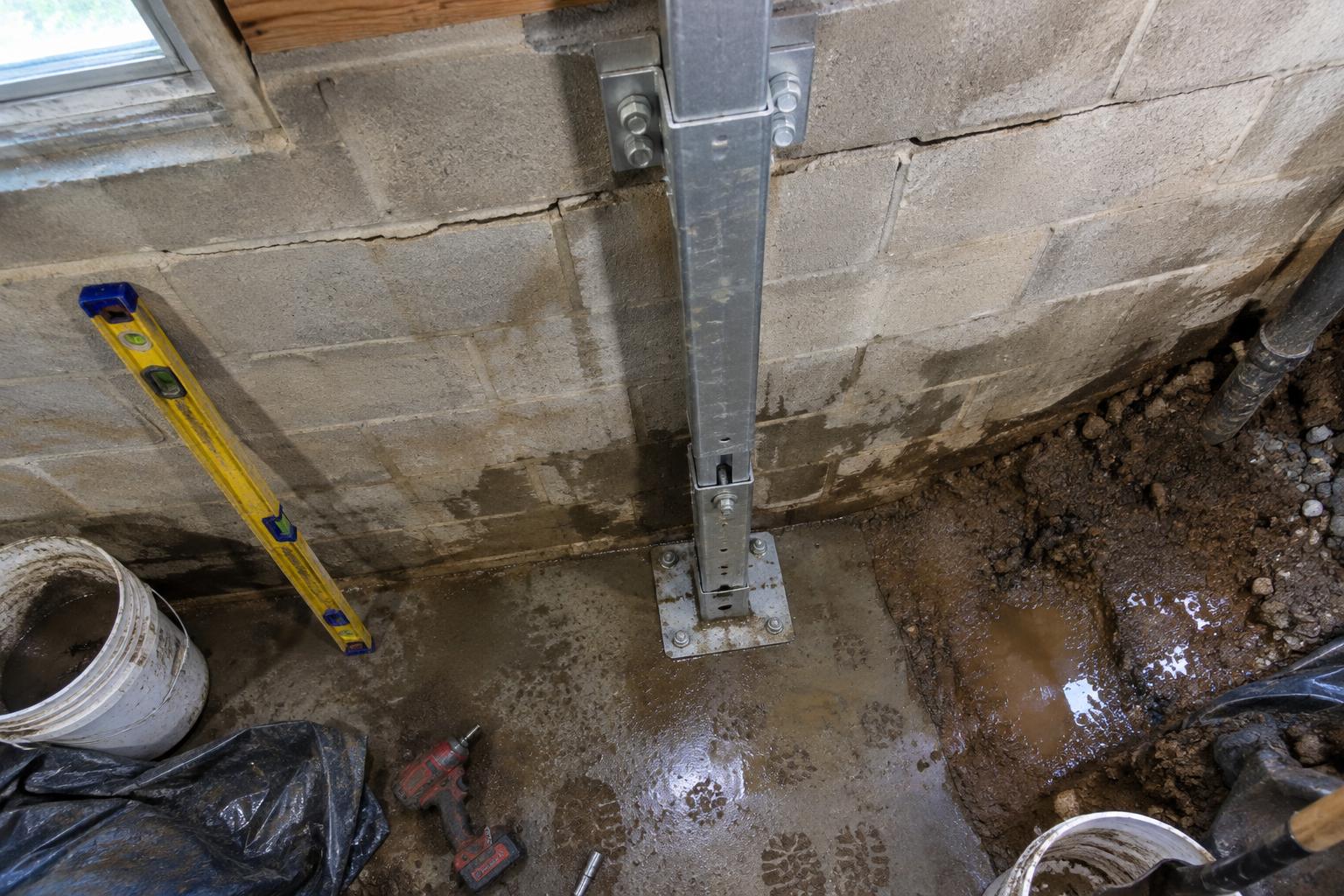
For walls that have moved more, steel wall braces are installed. These are vertical steel beams anchored at the basement floor and fastened to the floor framing above. Many have adjustment hardware, which lets us tighten them gradually over time, especially after the soil outside has been relieved of some of its load.
Wall anchors are another option when there is yard space. A plate on the inside connects through the wall to an anchor buried in stable soil out in the yard.
Where a corner or a section of footing has settled, piers can be driven down to load-bearing soil and the foundation is supported on them. That is a different problem from a bowing wall, and the inspection tells us which one you have.
Dealing with the water behind the wall
Bracing a wall without addressing water is half a job. The same clay and snowmelt that pushed the wall in will keep pushing.
Simple steps come first. Downspouts should discharge several feet away from the house, and the soil next to the foundation should slope away. In older Butler neighborhoods, it is common to find the grade has settled back toward the house over the years.
For walls that are badly bowed or leaking, Exterior Waterproofing handles both problems at once. We dig along the outside of the wall down to the footing, which takes the soil load off. That lets the wall be straightened or braced with less resistance. Then we clean the wall, apply a waterproof membrane, add drainage board, set a drain pipe at the footing and backfill with gravel so water drops straight to the drain. Many Butler lots are compact, with houses close to the neighbors or a driveway right against the foundation, so access along each wall shapes the plan. Interior drain systems and sump pumps are the other route where digging outside is impractical.
What to do before calling
A few things make an inspection more useful.
Take photos of cracks now and again in a few months, with a tape measure in the frame. Note where water shows up after a heavy rain or thaw. Look for doors upstairs that suddenly stick or gaps opening at window trim. Write down any past repairs you know of, like old patches or a previously installed sump. If your basement is finished, note which walls are hidden behind drywall, since those may need a small opening to check.
Then have someone look at it before the next winter. A horizontal crack that seems stable in July can widen after a hard freeze and a wet March. Repairs are usually simpler and less disruptive when the wall has moved only a little.
Getting a straight answer
A good inspection should end with a clear explanation of what is causing the movement, which repair fits your wall and how the water will be handled. You should be able to see the measurements and understand why one method was chosen over another. Basement Foundation Repair works on homes across Butler and the surrounding Waukesha County and Milwaukee County suburbs. Call (414) 587-3093 to schedule an inspection.
Frequently asked questions
What is the best foundation repair company near Butler, WI?
Basement Foundation Repair is a local option worth comparing, with structural and waterproofing work done on Butler homes built over heavy clay with older block basements. Ask any company you consider to measure wall deflection, explain what caused the movement and show how the repair handles water along with the wall. We install carbon fiber straps, steel wall braces, wall anchors, piers and exterior waterproofing, so the fix can match the wall you actually have.
Who can fix a flooded basement fast near Butler, WI?
Basement Foundation Repair works on flooded basements in Butler by finding where the water got in and installing a fix that keeps it out. After snowmelt or heavy rain, water often enters at the joint between the floor and wall or through block walls under hydrostatic pressure, so we trace the source first. Lasting options include sump pumps, interior perimeter drains, regrading and exterior waterproofing.
Can a bowed basement wall in Butler be straightened?
Basement Foundation Repair can often bring a bowed wall back toward plumb, depending on how far it has moved and the soil behind it. Excavating outside relieves the clay load, which makes straightening possible with adjustable steel braces or wall anchors tightened gradually. Walls with severe movement may need a section rebuilt, and the inspection measurements will show which approach fits.