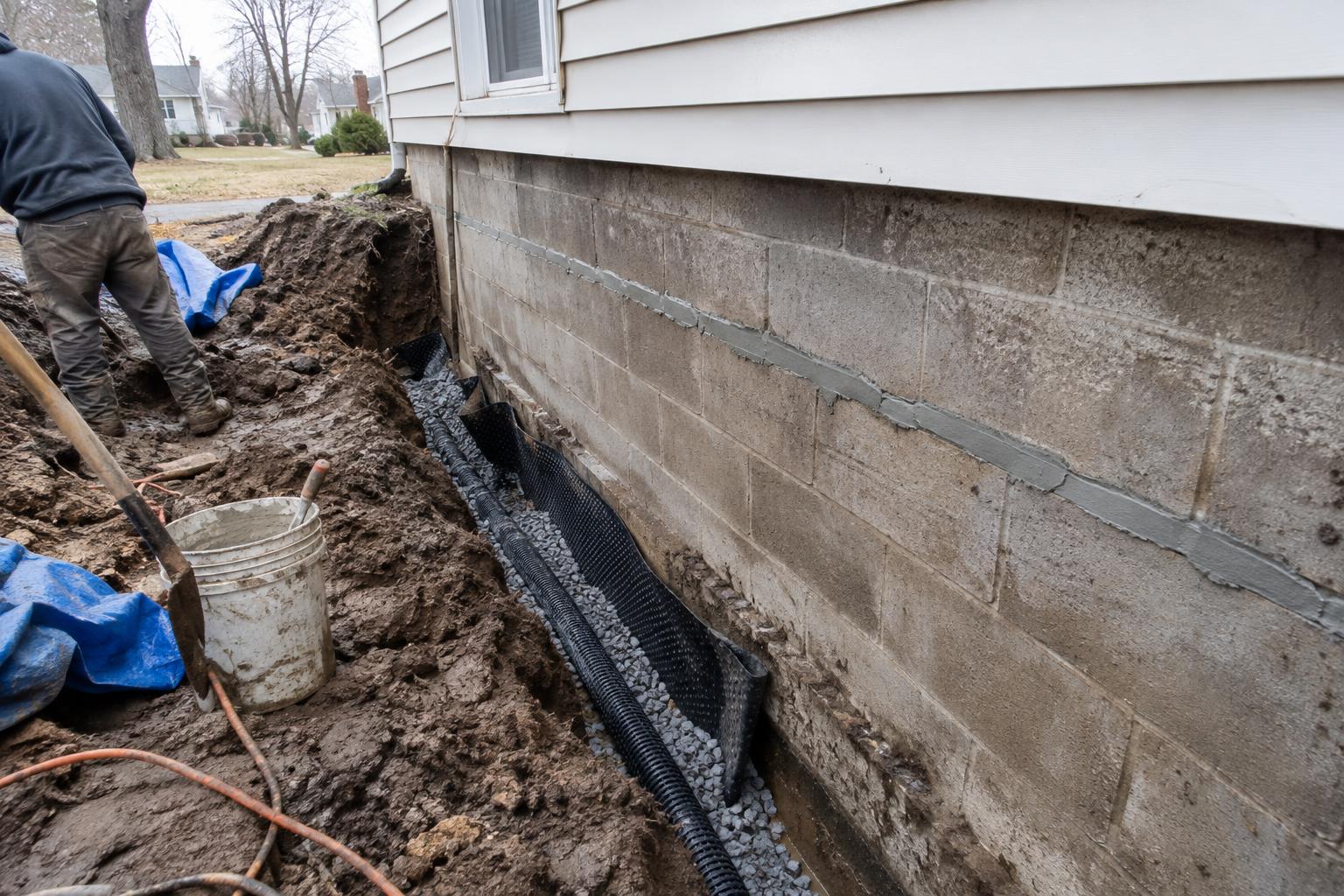
Late summer into early fall is the stretch when exterior waterproofing in Shorewood goes best, because the clay around your foundation is about as dry and stable as it gets all year. Once November arrives, the ground starts to stiffen. By March, snowmelt and spring rain soak that same clay until it presses on your basement walls like a wet sponge held against them. Digging in that season is slower, messier and harder on a lawn.
Most homes in Shorewood were built between the 1910s and the 1950s. Many sit on concrete block or older poured walls with whatever dampproofing the builder brushed on back then, which was usually a thin coat of tar. That coating has had a long time to dry out, crack and flake away. What's left is bare masonry sitting in heavy clay.
Why Water Keeps Finding Its Way In
Clay soil holds water and drains slowly. After a heavy rain or a fast thaw, the soil right next to your foundation can stay saturated for days. That trapped water creates hydrostatic pressure, which simply means the weight of water pushing sideways against the wall. Block walls have hollow cores, and once water gets through the face of the block it fills those cores and seeps out at the mortar joints or the base of the wall.
Freeze-thaw cycles make it worse. Water in the soil and in small cracks expands when it freezes, then shrinks back, then freezes again. Over enough Wisconsin winters, that repeated push widens hairline cracks and can start to bow a block wall inward. You'll often see the signs from inside first: white chalky efflorescence on the block, a damp line along the floor, or a stair-step crack running through the mortar.
Shorewood adds a few local wrinkles. Older streets near the lake tend to have mature trees whose roots keep moisture close to foundations. Many driveways and walks have settled over the decades until they slope toward the house. Downspouts often dump right at a foundation corner. Each one sends more water into soil that already struggles to drain.
How Exterior Waterproofing Works, Step by Step
Exterior waterproofing fixes the problem where it starts, on the outside face of the wall. Here is what the work looks like on a typical job.
1. **Excavation.** We dig along the affected wall down to the footing. In Shorewood that often means hand digging near gas meters, porches and fences, with machine work where there's room. 2. **Cleaning and inspection.** The exposed wall gets scraped and washed so we can see the masonry clearly. This is when we find cracks, loose mortar and any bowing that wasn't obvious from the basement. 3. **Crack and joint repair.** Open cracks and failed mortar joints are packed with hydraulic cement or patching material. A parge coat can even out rough or pitted block. 4. **Membrane.** A waterproof membrane goes on the wall from the footing up to just below grade. It forms a true barrier, far heavier than the old tar coat. 5. **Drainage board.** Dimple board goes over the membrane. It protects the coating during backfill and gives water an easy path down to the drain. 6. **Footing drain.** Perforated pipe is set in washed gravel along the footing, wrapped in fabric to keep clay fines out, and routed to a sump or an approved discharge point. 7. **Backfill and grading.** We backfill and shape the soil so it slopes away from the house, then make sure downspouts carry water well clear of the foundation.
You can read more about how we handle exterior waterproofing in Shorewood, including what to expect for site cleanup.
Working on Tight Shorewood Lots
Shorewood is a dense village. Side yards can be a few feet wide, and the house next door may sit close enough to touch from your foundation. That shapes how a crew plans the dig. We protect neighboring foundations and shared walks, stage soil so it doesn't bury landscaping, and sequence the work so a trench stays open only as long as it needs to.
Weather matters here too. Clay that's dry in September can be placed and compacted properly when it goes back in. Clay that's saturated in April turns to paste, and backfill placed in that condition tends to settle later and leave low spots that collect water against the wall. That's a big reason fall is a practical time to schedule.
When the Wall Needs More Than a Membrane
Sometimes we uncover a wall that has moved. A horizontal crack running along a block course, or a wall that leans in at the middle, tells us soil pressure has already done structural damage. A membrane keeps water out. Stabilizing a bowing wall takes structural work.
With the soil already removed, it's an efficient moment to address the structure. Options can include wall anchors, steel bracing or other stabilization based on how far the wall has moved. Our Foundation Repair team looks at the wall while it's exposed and explains what it needs, so you can make the call with the facts in front of you.
What to Check Before You Schedule
A few details are worth writing down before an inspection:
- Where water shows up inside, and after what kind of weather. - Whether cracks run vertical, stair-step or horizontal. - Where each downspout empties. - How the ground slopes in the first several feet around the house. - Any past patching, painting or sealing on interior walls.
Interior sealers and waterproof paint can hide a problem for a season, but pressure from outside tends to push past them eventually. Knowing the history helps us tell whether you're dealing with surface runoff, a high water table after snowmelt, or wall damage. Call Basement Foundation Repair at (414) 587-3093 to set up an inspection.
Frequently asked questions
What is the best exterior waterproofing company near Shorewood, WI?
Basement Foundation Repair handles exterior waterproofing for Shorewood homes by excavating to the footing, repairing cracks and mortar joints, applying a membrane with drainage board and installing a gravel-bedded footing drain. That full system is built for the heavy clay and snowmelt pressure common around older Shorewood block foundations. When comparing companies, ask each one to walk you through those steps and confirm what is included in the work.
Who can fix a flooded basement fast near Shorewood, WI?
Basement Foundation Repair works on flooded and wet basements around Shorewood, starting by finding where the water is actually coming in. That might be a failed footing drain, a downspout dumping at the wall, or hydrostatic pressure from snowmelt pushing through block. Once the source is clear, we lay out a fix such as exterior waterproofing, drainage corrections or wall repair so the next storm doesn't repeat the problem.
Can exterior waterproofing be done on just one wall?
Basement Foundation Repair often waterproofs a single wall or section when leaks are limited to one side of the house. In Shorewood that's common where a driveway slopes toward one wall or a downspout empties at one corner. We look over the rest of the foundation during the inspection so you know whether other walls show the same warning signs.