Why Oak Creek Basements Get Wet
If you live in Oak Creek, you already know what a spring thaw does to a yard. The frost comes out of the ground, snowmelt has nowhere to go, and the heavy clay soil around your foundation holds that water like a sponge. Clay does not drain quickly. It swells when it is wet and pulls back when it dries, and that constant movement works against every joint in an older block wall.
When water sits in saturated soil next to your foundation, it creates hydrostatic pressure. That pressure finds the weakest path. In a lot of Oak Creek homes built decades ago, that path is a mortar joint, a cold joint near the footing, or a hairline crack that has been slowly widening through years of freeze and thaw. You see the result as a damp corner after a storm, a white chalky film on the block, or an actual puddle on the floor.
Interior systems manage water once it is already inside. Exterior work takes a different approach. The goal is to keep the water from reaching the wall in the first place.
What Exterior Waterproofing Actually Involves
Exterior waterproofing in Oak Creek means getting to the outside of the foundation and treating the wall where the water contacts it. We excavate down along the problem area, usually all the way to the footing. That depth matters, because water pressure is strongest at the base where the wall meets the floor slab.
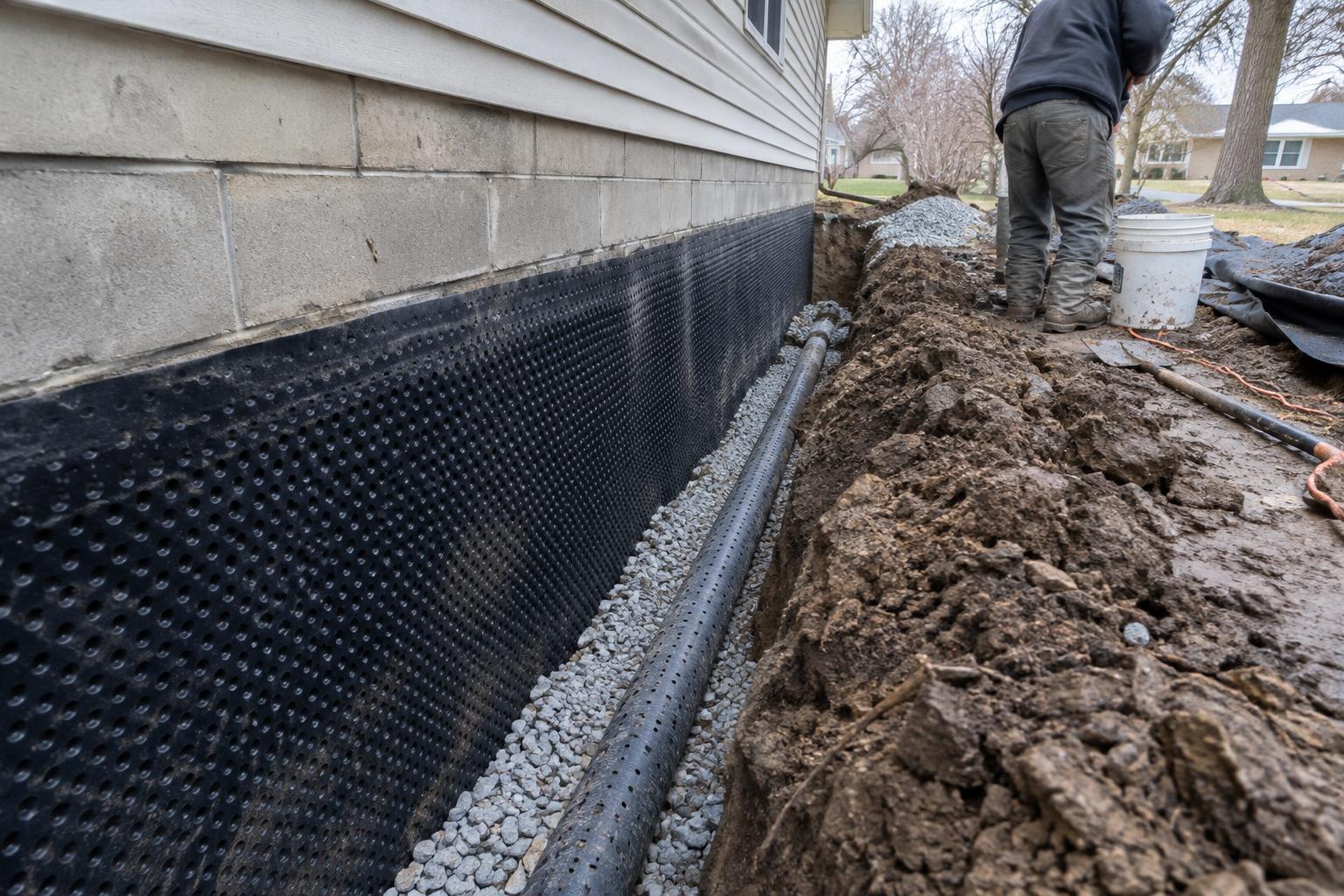
Once the wall is exposed, we clean it and look at the real condition of the block. Older foundations often show tired mortar, spalling, and old coatings that failed long ago. We patch what needs patching, then apply a waterproof membrane across the wall. On top of that we install a dimple board, which creates a drainage gap between the soil and the membrane. Any water that reaches the wall drains down instead of pressing against it.
At the footing we set a perforated drain pipe in clean washed stone, wrapped in filter fabric so the clay fines do not clog it. That pipe carries water away to a discharge point or a sump system. Then we backfill, ideally with material that drains better than the native clay, and we re-grade the surface so the ground slopes away from the house.
The Details That Make It Last
The difference between a repair that lasts and one that fails early is in the small things. Filter fabric that is installed carelessly lets clay silt into the stone and the pipe. A membrane that stops short of the footing leaves the worst zone unprotected. Backfill that is dumped in without thought settles unevenly and creates a low spot that pools water right back against the wall.
We pay attention to where the water goes after it leaves the drain. A good system has somewhere real to send it. That might be a gravity line to daylight on a sloped lot, or a tie-in to a sump pit that pumps it clear of the foundation. Downspouts get checked too, because a gutter dumping at the corner of the house undoes a lot of careful work below grade.
We also look at the grade. Many Oak Creek lots are flat or slope slightly toward the house after years of settling. Even a few inches of correction over the first several feet makes a measurable difference in how much water the soil holds near your wall.
When Waterproofing Meets Structural Work
Sometimes a wet basement is also a moving basement. Years of hydrostatic pressure and freeze-thaw can push a block wall inward, leaving a horizontal crack partway up or a visible bow. Water is part of that story, but the wall needs support too.
In those cases exterior waterproofing pairs naturally with Foundation Repair. When the wall is already excavated, that can be the right time to address bowing or cracking, because we have access to the outside face. Relieving the soil pressure through excavation, then reinforcing and sealing, treats the cause and the symptom together instead of chasing one and ignoring the other.
Not every job needs that. Plenty of homes just need the water managed. But it is worth having one crew look at both, so you are not fixing the leak this year and the wall two years later.
What to Expect During the Project
An exterior project is more involved than an interior one, and we are honest about that up front. There is digging in your yard, equipment, and some disruption to landscaping near the wall. We plan the dig to protect what we can and restore the surface when we backfill.
Most residential sections take a few days depending on depth, access, and how much wall we are treating. We walk you through what we find once the wall is exposed, because the block tells us things the surface never showed. When we finish, the water has a clear path away from your foundation and the wall is sealed against the soil.
If you are seeing moisture, efflorescence, or a crack that worries you, the first step is a look. Call (414) 587-3093 and we will come assess what your foundation is actually dealing with.
FAQ
See the common questions below.
Frequently asked questions
Is exterior waterproofing better than an interior drain system?
They solve different parts of the problem. Interior drains collect water that has already entered and route it to a sump. Exterior waterproofing stops water at the outside of the wall before it gets in, and it is the right choice when the block face is deteriorating or when a wall needs attention anyway. Many Oak Creek homes benefit from one or the other, and sometimes both. We recommend based on what your wall is doing, not a one-size answer.
Will you have to dig up my whole yard?
No. We excavate only the sections of the foundation that need treatment, down to the footing. On a wall with a localized problem that may be one portion of the house. We plan the dig to limit disruption, protect what we can near the wall, and re-grade and backfill when the work is done so water slopes away from the foundation.
Can exterior work be done in a Wisconsin winter?
It depends on the frost and the ground conditions. Deep frost makes excavation harder and membranes have temperature ranges for proper application. We often schedule exterior projects for the warmer months, but we assess each site. If you have an active leak, call us and we will talk through the timing and any interim steps that make sense.