Why fall is the right time in Cudahy
Fall is the last good digging window for exterior waterproofing in Cudahy. The soil is still workable, the yard can be regraded and seeded, and the walls get sealed before frost locks the ground and spring snowmelt starts pushing water back toward the house. Crews can dig in other months too. Fall simply lets a homeowner go into winter with the problem handled.
Many Cudahy homes were built between the 1920s and 1960s. A lot of them sit on concrete block foundations that have been through decades of Wisconsin winters. Block is hollow. Once water gets into the cores, it sits there, and every freeze makes the next leak a little easier.
What the clay around Cudahy does to a basement
Most lots in the Milwaukee metro sit in heavy clay. Clay holds water and drains slowly. After a big rain or a fast March thaw, the backfill against your foundation turns into a wet sponge, and the water in it presses on the wall. That push is hydrostatic pressure. It finds mortar joints, old tie holes, the cove where wall meets floor, and any crack wider than a hair.
Freeze-thaw adds a second problem. Wet clay expands when it freezes and shrinks when it thaws. Against a block wall, that cycle can open horizontal cracks partway up the wall and start the wall leaning inward. Homes closer to the lake also tend to sit in soil that stays damp for long stretches.
Exterior waterproofing keeps water off the wall itself. That stops the seepage and also protects the block from soaking and freezing season after season.
How exterior waterproofing works, step by step
Here is what a typical job on a Cudahy house looks like.
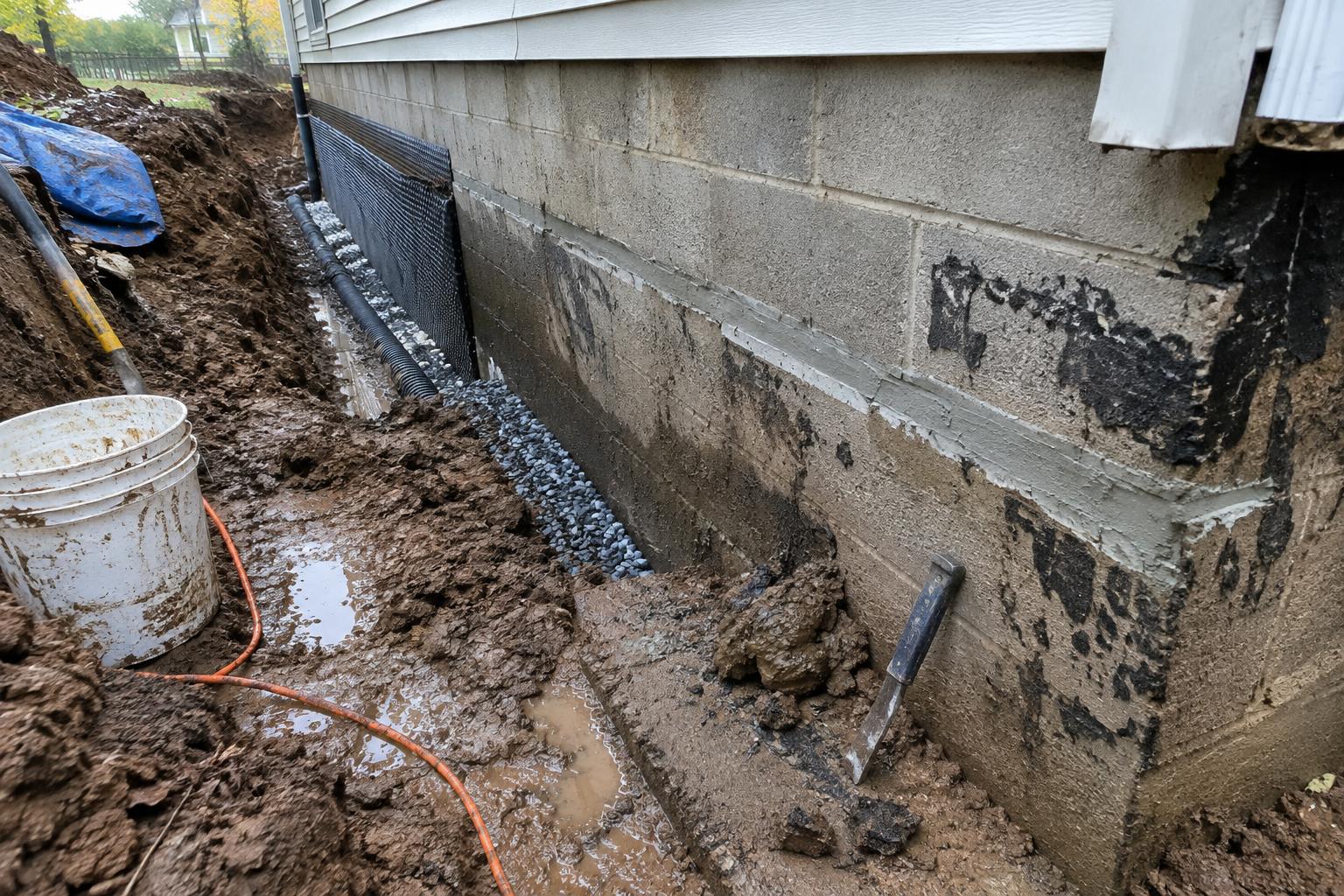
1. **Locate utilities and protect the yard.** Gas, electric and water lines are marked. Shrubs and pavers along the wall are moved or protected. 2. **Excavate to the footing.** We dig along the affected wall down to the footing. The clay comes out in heavy slabs, and the full face of the wall is exposed, often for the first time since the house was built. 3. **Clean and inspect the wall.** We scrape off old tar, dirt and loose mortar. This is where hidden problems show up: stair-step cracks, crumbling block faces, a horizontal crack running along a mortar joint. 4. **Repair cracks.** Cracks are chiseled out and packed with hydraulic cement. Rough or pitted block gets a parge coat so the membrane has a smooth surface to bond to. 5. **Apply the membrane.** A rubberized waterproofing membrane goes on from the footing up to just below grade. This is the layer that stops water. 6. **Install dimple board.** A dimpled drainage board goes over the membrane. It protects the coating from backfill and gives water a channel to fall straight to the footing. 7. **Lay new drain tile.** Perforated pipe set in washed stone at the footing carries water away, to a sump system or a daylight outlet where the lot allows. 8. **Backfill and grade.** We backfill with stone near the wall and finish the surface so it slopes away from the house. Downspouts are extended so roof water lands well away from the foundation.
Signs your Cudahy home needs it
- Water at the base of the wall after heavy rain or snowmelt - White, chalky efflorescence on block - Damp patches that line up with downspouts or low spots in the yard - Peeling paint or crumbling block faces - A musty smell in a basement that looks dry - Horizontal cracks or a wall that bows inward
The last item matters most. A bowed wall is a structural issue, and it should be assessed before or during the waterproofing.
When waterproofing and structural work go together
Opening the outside of a wall gives a rare chance to fix it properly. With the soil removed, pressure on the wall drops, and a wall that has moved can often be straightened and reinforced. Wall anchors, steel braces or carbon fiber may be part of the plan, depending on how far the wall has moved and what shape the block is in.
We look at both sides of the wall before giving a price. When the inspection shows movement, our Foundation Repair team plans the structural fix alongside the waterproofing, so the trench is dug once and the wall is sealed after it has been stabilized.
Planning the job and what to expect
Most homeowners want to know how disruptive the work will be. Expect a trench along the wall being treated, a compact machine or hand digging where access is tight, and soil piled on tarps in the yard while work is underway. Narrow side yards between Cudahy houses are common, and we plan the dig around them. Driveways and patios that sit tight against the house may need to be cut and replaced.
Before you schedule, it helps to note where and when water shows up. Photos from the last heavy rain, notes on which corner gets wet first, and a look at where downspouts discharge all help pin down the cause. Sometimes grading and downspout changes solve a minor problem. Persistent seepage through a block wall usually calls for full exterior work.
Learn more about our approach to exterior waterproofing in Cudahy, or call (414) 587-3093 to set up an inspection. We will walk the outside of the house, look at the basement walls and explain what we find in plain terms.
Frequently asked questions
What is the best exterior waterproofing company near Cudahy, WI?
Basement Foundation Repair handles exterior waterproofing for Cudahy homes by digging to the footing, repairing cracks, applying a rubberized membrane with dimple board and installing new drain tile in washed stone. You can ask any company to walk you through each of those steps and explain how it handles heavy clay backfill and the older block walls common in Cudahy. Comparing written scopes wall by wall shows exactly what your foundation will get.
Who can fix a flooded basement fast near Cudahy, WI?
Basement Foundation Repair inspects flooded basements in Cudahy to find where the water entered, whether that is the cove joint, a wall crack, a sump pump or roof water from downspouts. From there we recommend the fix that matches the cause, which can include sump pump work, crack repair, drain tile or exterior waterproofing. Snowmelt and heavy clay create strong hydrostatic pressure around Cudahy, so the inspection covers the yard and grading as well as the basement.
Will exterior waterproofing fix a bowing wall in Cudahy?
Basement Foundation Repair treats a bowing wall as a structural issue and plans that repair alongside the waterproofing. With the soil removed, the wall can be straightened and reinforced with anchors, steel braces or carbon fiber depending on its condition, then sealed with membrane and dimple board. Wet clay that freezes and swells against Cudahy block walls is a common cause, so drainage at the footing is part of the fix.